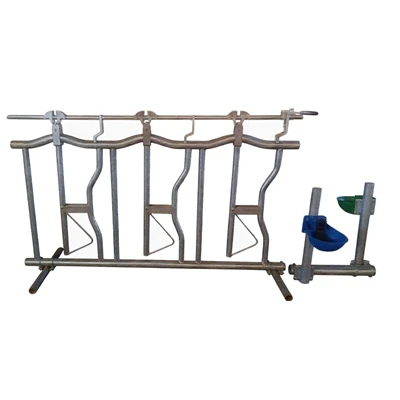
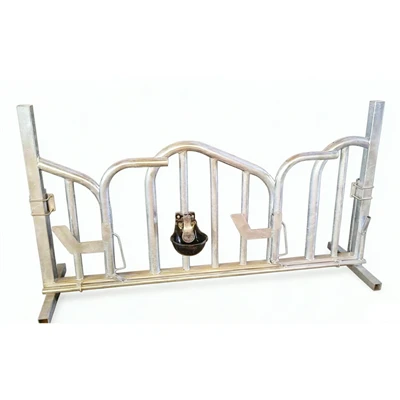
What is Gestation Crate?
Gestation crate are narrow cages barely bigger than an adult pig — about 7 feet by 2 feet. Female pigs, also called sows, are locked into gestation crates after they become pregnant, where they will remain until after they give birth. The crates’ floors are made up of metal bars so the pigs’ feces can fall directly into a pit below. Usually, the pigs are unable to sit down for weeks on end.
Advantages of Gestation Crate
Save space
The sow positioning bar is adopted in the breeding farm, which effectively reduces and reduces the floor area of the sow house in the pig farm, and greatly improves the utilization rate of the sow house area. The service life is much longer than that of ordinary cold galvanized pipe.
Convenient management
Using the sow positioning bar, the staff is more convenient and efficient in the management, cleaning and epidemic prevention of sows. The bottom of the feed trough is fixed with a three grip design, which effectively avoids the waste of feed caused by the excessive force of sows to arch over the feed trough.
Improve utilization
Sow positioning bar can reduce the amount of exercise of sows. It is conceivable that it will improve the utilization rate of feed and avoid the physical waste caused by excessive exercise of sows.
Improve productivity
With the sow positioning bar, there is no need to worry about injury or abortion caused by fighting with other pigs, which greatly improves the productivity of sows. We should pay attention to it and make every step for the production environment of sows.
-
![Pig Gestation Stall]() Pig Gestation StallBase Information of pig Gestation stall
-
![Pig Gestation Crate With Feeder]() Pig Gestation Crate With FeederProduction Descreption of Pig gestation stall The gestation stall(individual stall) is usually used for insemination or gestation sows. It can make the insemination easier, and can protect the
-
![Pig Gestation Crate With Floors]() Pig Gestation Crate With FloorsProduction Descreption of Pig gestation stall The gestation stall(individual stall) is usually used for insemination or gestation sows. It can make the insemination easier, and can protect the
-
![Pig Gestation Crates From SHENGXIN]() Pig Gestation Crates From SHENGXINBase Information of pig Gestation stall
-
![Pig Gestation Crate With Drinker]() Pig Gestation Crate With DrinkerProduction Descreption of Pig gestation stall The gestation stall(individual stall) is usually used for insemination or gestation sows. It can make the insemination easier, and can protect the
-
![Pig Equipment Pig Farrowing Crate With PVC Fence Livestock Machinery]() Pig Equipment Pig Farrowing Crate With PVC Fence Livestock MachineryBase Information of pig Gestation stall in Shengxin
-
![Pig Gestation Stall In Shengxin]() Pig Gestation Stall In ShengxinBase Information of pig Gestation stall in Shengxin
-
![Hot Galvanized Pig Gestation Crates]() Hot Galvanized Pig Gestation CratesBase Information of pig Gestation stall
-
![Hot Galvanizing Pig Gestation Crates From SHENGXIN]() Hot Galvanizing Pig Gestation Crates From SHENGXINBase Information of pig Gestation stall
-
![Pig Gestation Crate]() Pig Gestation CrateProduction Descreption of Pig gestation stall The gestation stall(individual stall) is usually used for insemination or gestation sows. It can make the insemination easier, and can protect the


Why Choose Us?
Rich experience
Dedicated to strict quality control and attentive customer service, our experienced staff is always available to discuss your requirements and ensure complete customer satisfaction.
Quality control
We have professional personnel to monitor the production process, inspect the products and ensure that the final product meets the required quality level standards, guidelines and specifications.
High quality
Our products are manufactured or executed to very high standards, using the finest materials and manufacturing processes.
24h online service
We try and respond to all concerns within 24 hours and our teams are always at your disposal in case of any emergencies.
What is the Difference Between a Farrowing Crate and a Gestation Crate
The main difference is that factory farms confine pigs in gestation crates during pregnancy, and keep pigs in farrowing crates after they give birth to a litter of piglets.
In the last few days of the pregnancy, sows move to farrowing crates, where they give birth to their piglets. These crates closely resemble gestation crates in that they enclose the mother’s body without enough room for the pig to turn around. But one side of the gate is grated, allowing the piglets to access the mother pig to nurse. The farrowing crate ultimately protects against a mother pig accidentally crushing her piglets, but it does so by completely preventing a mother pig from accessing her newborn piglets. She can’t build a nest for her piglets, groom them, bond with them, or communicate with them as she would in the wild.
Both gestation and farrowing crates are standard in the multi-billion dollar pork industry, which views mother and baby pigs as mere products—a way to make the most profits at the pigs’ expense.

Why do Farmers Use Gestation Crates
The meat industry uses gestation crates to maximize profits at the expense of animals’ physical and mental well-being. By keeping pregnant pigs confined in the small crates, industrial farmers can crowd thousands of breeding sows inside a single shed. They don’t need to worry about controlling the amount a sow eats or handling the unique social hierarchies that sows establish in the wild. Housing pigs like this requires the bare minimum of personnel needed to manage the animals.
While industrial farmers argue that sows have more piglets when confined to gestation crates, a new study shows that these crates are actually less productive. Researchers analyzed 17 different countries: Some where gestation crates are the norm, some where the crates are restricted, and others where gestation crates are completely banned. They found that rates of sow mortality were highest in countries with gestation crates. And not only that—they found that pig production per sow was “significantly lower” in those countries, too.
Due to the sheer amount of individual sows in a shed, many pigs face severe forms of neglect and horrific conditions. They wallow in built-up feces and filth. They rarely receive care for any of the pain or injuries they suffer from life in the crate. Some are even left to die on the concrete floors of factory farms. Although tragic, the industry overlooks these premature losses. They only want to keep mother pigs alive long enough to produce between three and five litters of piglets.

The pork industry argues that gestation crates are humane and necessary for production, preventing animals from hurting one another and allowing farmers to monitor their health closely. Yet these goals are achieved by placing an incredible level of restriction on these pregnant pigs — limiting even modest movement.
Pigs in captivity are known to bite each other when kept in close quarters. To animal researchers and farmers, this is a serious welfare concern. Research into pig welfare shows that a lack of environmental enrichment is the most prominent cause of tail-biting.
Pigs have a very sensitive social structure. When placed into group housing systems pigs are more likely to be injured due to aggressive behavior from the other pregnant pigs. By separating all of the pigs and placing them into individual cages the risk of being injured by other pigs goes away. Producers are also better able to regulate the amount of food provided to each individual animal. However, the cost for the welfare of the mother pig is very high, as she is not able to engage in natural behaviors or even turn around in her cage. Pigs living in gestation crates are constantly stressed and suffer both physically and psychologically.
Like most standard factory farm practices, gestation crates’ ultimate purpose is maximizing profits. Keeping pigs in the tightest spaces possible allows meat producers to fit thousands of pigs into a single farm, raising their bottom line at the expense of animal welfare. To protect their profits, pork producers often claim that there are no viable alternatives to the cruelty of crate confinement. However, less cruel alternatives do exist.
Instead of confining sows to individual cages, some farms opt for group housing—one of the most common alternatives to gestation crates. In group housing, animals have the freedom to move around and socialize with other pigs, free from the confines of an individual crate.
Although preferable to the agony of crate confinement, pigs still suffer in group housing. Group housing doesn’t guarantee outdoor access, nor does it prevent overcrowding. The pens can have the same slatted floors as gestation crates, making for entirely barren environments. Pigs still spend their entire life in a filthy, windowless shed, without ever seeing the sun.
Small farms use pasture systems as a more natural, humane option for raising pigs. In these systems, farmers leave herds of pigs to their own devices, allowing them to roam around outside and take shelter in huts that they frequent at their choosing. Although pasture systems provide pigs with a much better life, sadly, pasture systems account for less than 3% of meat production in the us. 97% of pigs experience life on a factory farm.
The bottom line is that millions of pigs suffer to end up on our plates, enduring cruel practices that are standard across the industry. However, switching to alternatives like group housing protects pigs from the worst form of confinement, allowing them to move with more freedom and sparing them from the painful injuries of crate confinement. Banning gestation crates and switching to alternative systems is a crucial first step toward a future where no pig has to suffer through life in the confines of a factory farm.
What Preparations do i Need to Use Gestation Crate
Gestation crate is raised on a high bed, the main purpose is to keep the sow farrowing house clean and tidy, isolated from the ground. The main function of gestation crate is to ensure the successful delivery of sows and speed up the recovery of sows after delivery. Therefore, the general pig farm will be equipped with gestation crate.
When installing gestation crate, pay attention to the height of the leakage floor from the ground to 30-45 cm.
After installing all gestation crate, clean and disinfect the farrowing house, and then leave it empty for two days to dry the farrowing house and sow bed.
The gestation crate that has been transferred to the sow should be kept hygienic in the farrowing bed.
Before using gestation crate again, clean and disinfect the gestation crate, and ensure that the sows are dry before transferring to the sows.
The feces under gestation crate should be removed in time to avoid bacterial contamination.
How to Choose Gestation Crate With Better Anti-Rust Effect
Many pig farms are faced with the problem of feed waste. Since this waste cannot be 100% prohibited, we can reduce this waste to an ideal range. The waste of feed is nothing more than the stages of storing feed, conveying feed and feeding feed.
In the production process of gestation crate, there is a welding process. The hot-dip galvanized pipe is firstly galvanized and then welded. Hot-dip galvanizing is firstly welded and then galvanized. During the welding process, the original for some galvanized layers, naturally, the anti-rust effect will definitely be different, and welding first and then galvanizing can avoid this kind of damage. Therefore, the majority of farmers choose hot-dip galvanized steel pipes when choosing gestation crate. If the galvanized layer is intact, it can prevent rust better, and the anti-rust effect is good, and the service life will be longer.
Nowadays, when raising pigs, everyone knows that it can provide a clean, safe and suitable environment for sow delivery and piglet care. The mainstream sow farrowing crate on the market now includes the single-body european sow farrowing crate, the double-body semi-plastic and semi-cast iron sow farrowing crate, the double body all-cast iron sow farrowing crate, and the composite board sow farrowing crate. The composite board sow farrowing crate is not recommended due to material problems. Compared with semi-plastic sow beds, twin-body all-cast iron sow beds are more expensive because of the material. More suitable for use in the south. The temperature in the south is generally higher. The use of all-cast iron sow farrowing crate can not only cool down, it is easy to clean, but also has sufficient water supply.
The european sow farrowing crate is a single sow farrowing bed. In other words, the european-style farrowing bed has only one sow position, and the european-style farrowing bed is generally more expensive. The double-body semi-plastic semi-cast iron sow bed is generally more affordable and more suitable for use in the north, because the weather in the north is relatively cold, and the all-cast iron sow bed is used. When it is cold, the piglet sleeps on the farrowing bed and it is easy to have diarrhea! The sows are prone to freezing during the farrowing bed.

Understand the situation of your own pig farm. First of all, farmers should know the size and area of their pig farm, and choose the appropriate sow farrowing crate according to the method of cleaning the pig farm;
Determine your approximate budget and production plan. Farmers need to have a complete production plan and budget for purchasing equipment. There are many specifications of sow farrowing crate, pig friends need to clarify the size and configuration of sow farrowing crate and related purchase quantity, etc.;
Understand the production capacity of the equipment. What you need to do now is to calculate the usage of each set of sow farrowing crates, which can be used by several sows, and determine the total number of pig sites required.
FAQ
Q: What is the difference between a gestation crate stall and a farrowing lactation crate?
Q: What size is a gestation crate?
Q: Why are gestation crates so small?
Q: What are the pros for gestation crates?
Q: Are gestation crates necessary?
Q: When were gestation crates first used?
Q: What are the alternatives to farrowing crates?
Q: Are farrowing crates safe?
Q: Why are sow stalls used?
Q: What is the difference between a farrowing crate and a farrowing hut?
Q: What is the difference between farrowing crates and gestation crates?
Q: Are farrowing crates necessary?
Q: Why do pig farmers use farrowing crates?
Q: Why are gestation crates good?
Q: What is a farrowing crate?
Q: What is an alternative to farrowing crates?
Q: How long are pigs kept in farrowing crates?
Q: What are the advantages of a farrowing crate?
Q: Is the farrowing crate better than the pen?
Q: How many farrowing crates do I need?
Qingdao Shengxin Metalware Co., Ltd. is one of the leading gestation crate manufacturers and suppliers in China, providing the best quality gestation crate with competitive price. Welcome to contact our factory to place orders.
gestation stalls with low price, Hot DIP Galvanized Gestation Crates for Pigs, Pig Gestation StallPopular Products